Bookshelf

Do you ever find yourself staring at people’s bookshelves when you have a zoom meeting? Do you snoop to see what people are reading while stuck in the airport, or on a plane/bus? I confess to all of the above.

I get distracted by other people’s books, and I love to learn about what people are reading. Helps me to consider my next book. Bookshelves are spectacular works of art and architecture to me.

I will probably want to read what you are reading. Here are some questions I’m thinking about asking the next time we get together and talk books.

·      What book would you read over and over again?

·      What book could you read in one sitting, it was that good?

·      What book made you pee your pants from laughing out loud, or made you throw up a little bit in your mouth?

·      Which book have you reread the most?

·      Which book is the one you’d like signed by the author?

·      What book kept you up way too late?

·      What did you read that made you weep uncontrollably?

·      What book is the one that holds the recipe to a good life?

If you’re interested in more book talking, then head over to the BUTTERCUP podcast and listen to what Zibby Owens of “Moms Don’t Have Time to Read Books” has to say on episode 37 (click bold link) which was our first time adding video to the audio podcast.

Sharing love of books with preschoolers at our lab school. Photo taken by Erika Pritchard.

Crafternoon: Bath Bombs

Looking for something to do with children during spring break. Try a craft and whip up some bath bombs during crafternoon. Bath bombs are easier to make than you would think.

 With four ingredients, you and your child(ren) can make bath bombs. Take the ingredients below and mix them in a bowl. Then get a mold and shape the ingredients into a ball. That is it.

 Supervise children at all times. Wear gloves. Follow safety considerations for children. This activity may need to be adjusted depending on the child’s age and/or ability.

 Next time your children are bored, make some special bath bombs and memories.

 Ingredients:

¼ Cup             Cornstarch  

2 ¼ Cups       Baking Soda

¾ Cup            Coconut, Canola, Sweet Almond, or Other

1 ¼ Cups       Granular Citric Acid (look for this in the canning section of grocery store)

1 Teaspoon  Essential oil or fragrance (optional)

½ Teaspoon Liquid Color (optional)


Let's go to school in the museum!

Professor Alessandra Landini from University of Modena-Reggio Emilia helps us discover meaningful connections when a public space like a museum collaborates with their neighborhood school. During the COVID-19 pandemic, Dr. Landini and her school community relocated to the town public Museum’s Palace, in Reggio Emilia, Italy. Musei Civici became their school during the pandemic.

Her community partnership sustained the education program. Everything like food and resources followed her and children. The pandemic is over, but partnership between museum and school remains. In the tradition of the atelier, artistic and cultural expression in childhood is enhanced when professionals have resources. Entities outside of Reggio Emilia schools support early childhood education in this region of Italy. Many community-based programs exist in Emilia-Romagna that have meaningful contributions for professionals working with young children.

It is nearly impossible to separate education from the community context in Reggio Emilia when wondering if you can bottle up this magic. When you come to Reggio Emilia it is possible to wonder how you can take some of this magic home with you. If you want to hear more about this community-based partnership between the Reggio Emilia school and the municipal museum, head over to the BUTTERCUP podcast (click on bold) and listen to Dr. Landini tell the amazing story.

Musei Civici in Reggio Emilia, Italia.

Follow me to the Musei Civici in Reggio Emilia, Italia.

Musei Civici in Reggio Emilia, Italia.

Musei Civici in Reggio Emilia, Italia.

Musei Civici in Reggio Emilia, Italia.

Circle time and then small group activities were done here the day we visited the Musei Civici in Reggio Emilia, Italia.

Light tables and ateliers. Musei Civici in Reggio Emilia, Italia.

Musei Civici in Reggio Emilia, Italia.

Studies in sealife. Musei Civici in Reggio Emilia, Italia.

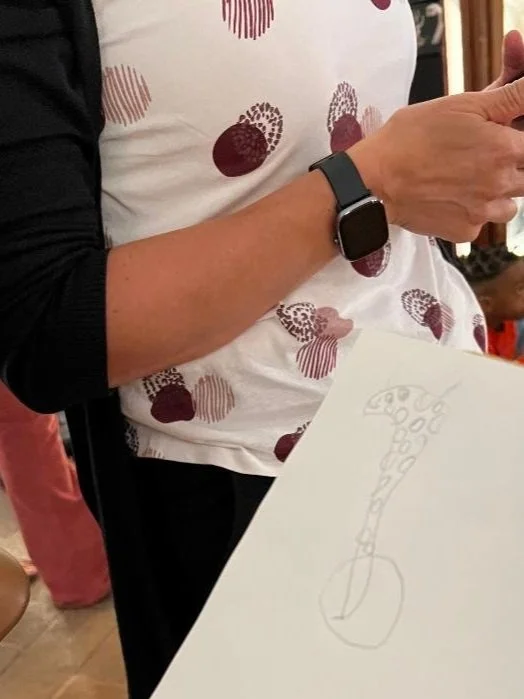
One child chose to draw this giraffe and then write about it in their journal. Musei Civici in Reggio Emilia, Italia.

Preschooler drew this giraffe in notebook. Musei Civici in Reggio Emilia, Italia.

Musei Civici in Reggio Emilia, Italia.

Musei Civici in Reggio Emilia, Italia.


Source: Landini, A. & Macy, M. (September, 2023). Case Study of Social Inclusion and Community-based Partnership in Reggio Emilia, Italia. Sixteenth International Conference on the Inclusive Museum, “Museum Transformations: Pathways to Community Engagement,” Vancouver, Canada.

The Day I Went to Harvard

“Learn to Change the World,” were the words on flags that hung from lamp posts on tree lined streets in Cambridge, Massachusetts. These inspirational words struck a nerve for me the day I went to Harvard. Economic prosperity for a community hinges on early childhood care for families. The reason I went to Harvard is to learn more about how children, families, and neighborhoods can prosper in rural areas.

Taking a selfie with my Harvard CEEL profs. Finally got to meet these incredible people in person after taking their classes for 2 years online trough Harvard Graduate School of Education. Left to right: me, Dr. Danila Crespin Zidovsky, and Dr. Emily Wiklund Hayhurst from Harvard and Saul Zaentz Early Education Initiative.

I learned about ‘Strengthening State and City Early Education Systems and Policy for Today & Tomorrow’ from emails I received from Zaentz Early Education Initiative at Harvard Graduate School of Education.

During the COVID-19 pandemic I was part of a certificate program called, Certificate in Early Education Leadership (CEEL). It took me about 2 years and 15 classes to earn the CEEL. I learned tons of cool things in this program about policy work, and how to advocate and serve children and their families.

CEEL prof: Dr. Nonie Lesaux

I developed a proposal to create a cross sector team who could explore workforce development that could benefit children and families in rural areas. Education, business, and health coming together to address the needs of our children in rural neighborhoods. The title: Recruitment & Retention of Professionals for Rural Communities in Education, Business, and Health Sectors Serving Young Children and their Families.

The proposal I wrote was accepted and our team attended the ‘Strengthening State and City Early Education Systems and Policy for Today & Tomorrow’ hosted by Zaentz Early Education Initiative at Harvard Graduate School of Education. They accepted 12 proposals. Mine was one of them. Thank you, Zaentz Foundation and team!

My team consisted of: Carime Ruvalcaba (early childhood educator, Cadre member of Buffett Early Childhood Institute, and business owner of Karime Childcare LLC serving children and families whose home language is Spanish), Cathy Lang (executive director of the Nebraska Business Development Center), Dawn Mollenkopf (professor who studies personnel preparation at University of Nebraska Kearney), Nikki Carritt (Assistant Vice Chancellor for Health Workforce Education Relations & Director of Rural Health Initiatives at University of Nebraska Medical Center; Assistant Director of Community Outreach & Engagement of Fred & Pamela Buffett Cancer Center; Nikki leads rural health initiative for University of Nebraska) and I.

“Learn to Change the World”

 Our team had homework assignments and two meetings before we went to Boston. Harvard executive ed programs use case method instruction. We read an in-depth case study about New York’s PreK for All program.

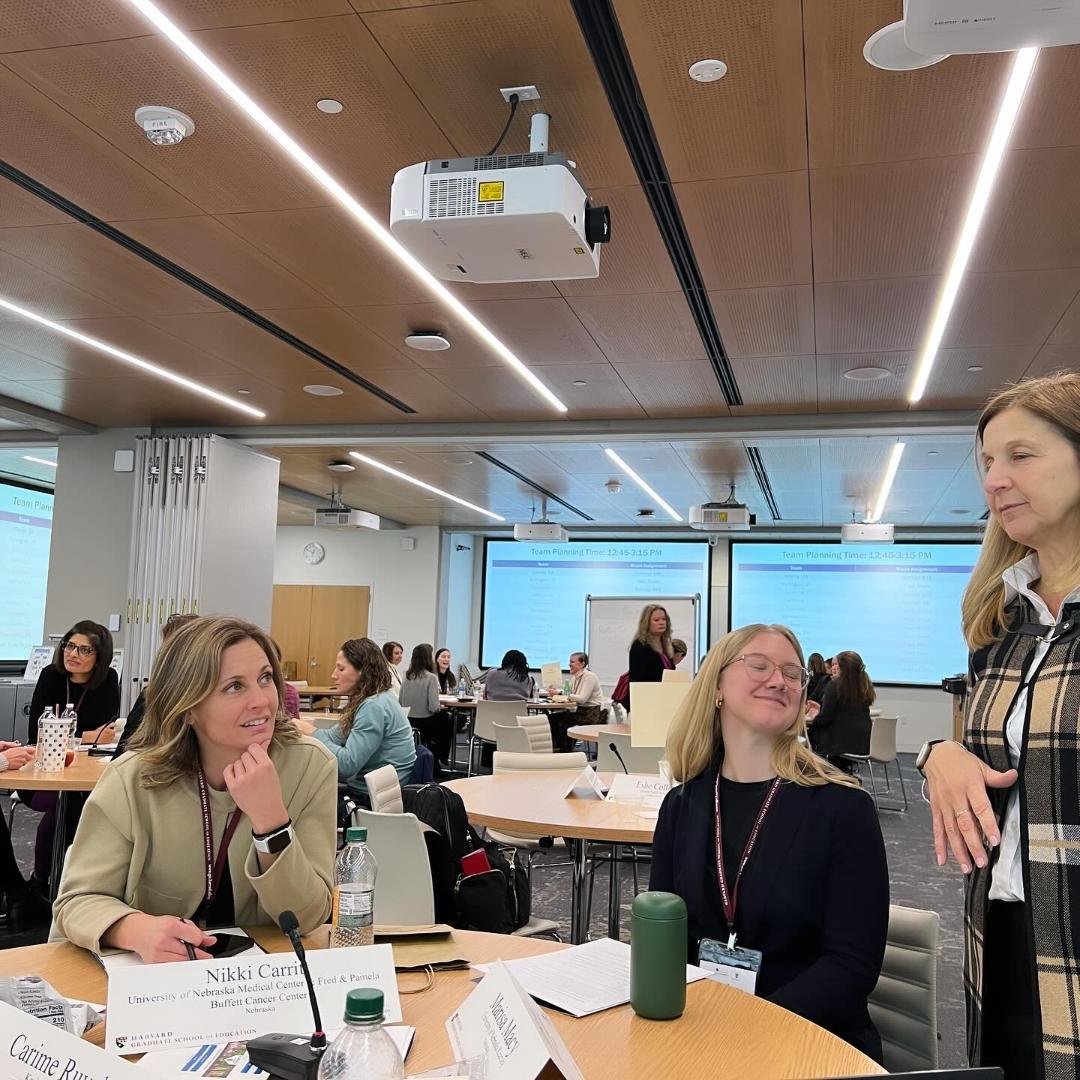
L. to R.: Cathy Lang, Nikki Carritt, me, and Carime Ruvalcaba

My team is trying to develop ways that could help us recruit and retain professionals who can serve children who are multi-language learners and their families in education, rural healthcare, and business to serve our rural communities in Nebraska. Our goal is to expand access and enhance the capacity of higher education to develop a strategic plan for collaboration and forming a rural hub network in Nebraska.

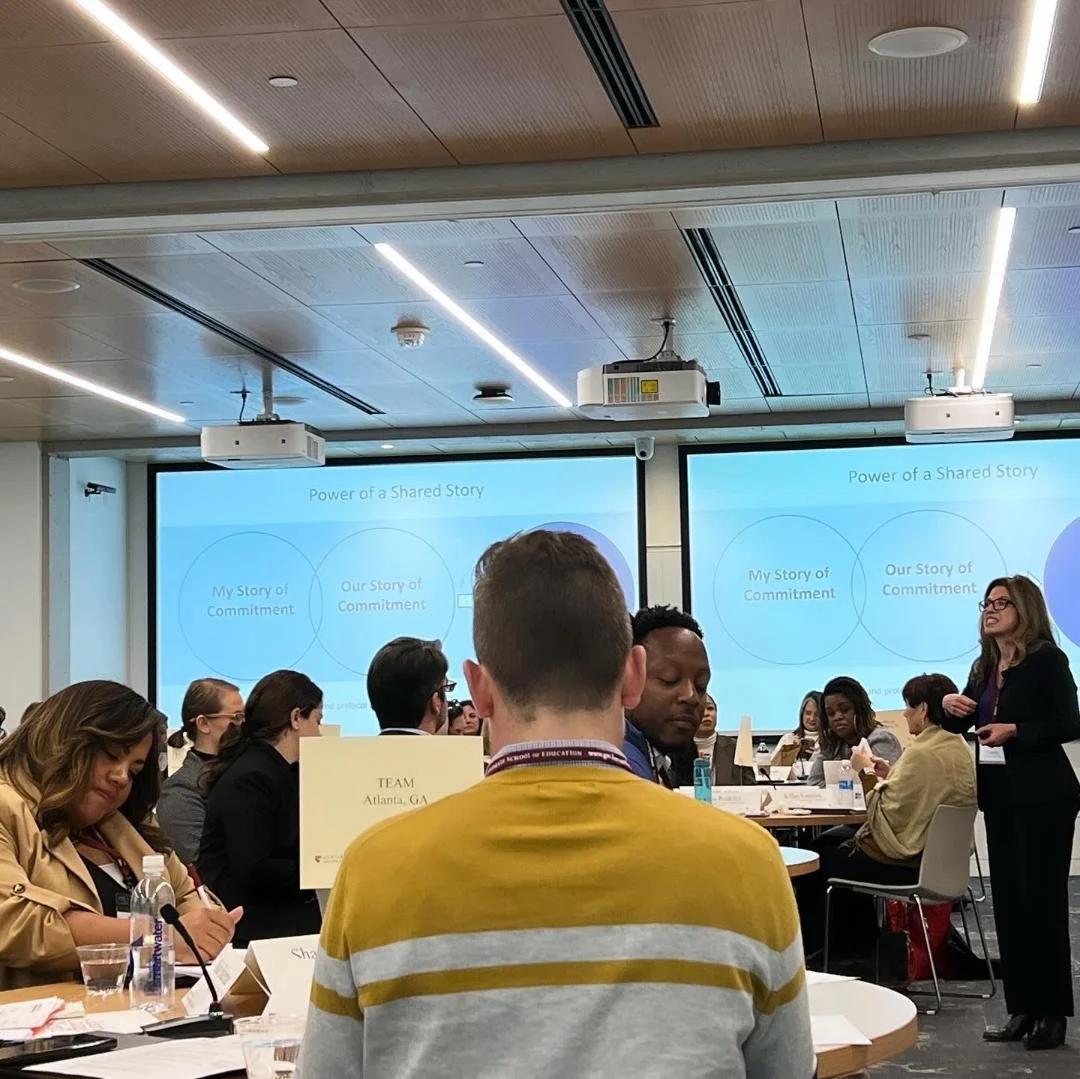
Gutman Library at Harvard is where we worked together with other teams. L. to R.: Cathy Lang, Nikki Carritt, me, and Carime Ruvalcaba

Our schedule for the day.

Our interdisciplinary team is focusing on two areas: (a) discussing policy implications for recruitment and retention of workforce to support regional rural hub model, and (b) creating an action plan to build coordination and expand access to resources for child care, health care, business, and early learning programs in rural areas.

Nikki Carritt (University of Nebraska Medical Center), Charlotte Petty (Harvard Graduate School of Education), and Robin Kane (Harvard Graduate School of Education).

Spectacular teams from Iowa, Colorado, California, Texas, Connecticut, Tennessee, Georgia, Vermont, and Pennsylvania. And of course our team from Nebraska. We did the lightening round with the team from Iowa. So interesting to hear about what the other teams are working on to help children and families.

I love to see Carime Ruvalcaba shine.

Carime and me walking in the snow in Cambridge.

Be ready! You never know who you’ll run into. Nikki and I running into the magnificent Dr.Jack Shonkoff (Harvard professor of pediatrics) at our hotel, The Commander, in Cambridge. He was there for a meeting the day we checked in.

“Our work today is like an intricately woven quilt,” ~Dr. Danila Crespin Zidovsky, Harvard Graduate School of Education.

The day I went to Harvard to explore early childhood education will go in my “smile file” forever. It was wonderful being there with an amazing team to learn from passionate people about how to better serve children and their families. Epic conversations can propel ideas and potential solutions for our rural communities struggling with workforce shortages. Conversations to be continued.

What does Hollywood have to do with Early Childhood Educators and Harvard?
Tune in to episode of BUTTERCUP podcast (click bold link) to hear interview with Harvard profs who provide professional development and resources to educators thanks to a gift from a Hollywood film producer who was a philanthropist, record producer, and won Academy Award 3x. Dr. Danila Crespin Zidovsky and Ms. Emily Wiklund Hayhurst share the Zaentz Early Childhood Initiative and resources for professionals.

Macy, M., Carritt, N., Lang, C., Ruvalcaba, C., & Mollenkop, D. (December, 2023). Recruitment & Retention of Professionals for Rural Communities in Education, Business, and Health Sectors Serving Young Children and their Families. “Strengthening State and City Early Education Systems and Policy for Today and Tomorrow” of Saul Zaentz Early Education Initiative at Harvard Graduate School of Education, Cambridge, Massachusetts.


Loris Malaguzzi Center in Reggio Emilia

The Malaguzzi Center is a charming and one-of-a-kind physical space that represents a beautiful tribute honoring children, families, professionals, and neighborhoods. The Loris Malaguzzi Center in Reggio Emilia, Italy is a place devoted to learning and discussing the ideas surrounding the early childhood education approach. People who go to Reggio Emilia for early childhood education delegations often spend at least one day at the Center. There are many things to do. For example, workshops on the Reggio Emilia model are offered by th Loris Malaguzzi Center.

The Reggio Emilia approach is named after the town of about 150,000 Italians living in the Emilia Romagna region of Italy. It is a child-centered and community-oriented model that uses fine arts as the foundation. The atelier is central to a Reggio Emilia classroom environment.

After World War II, the people of Reggio Emilia were outraged by what the war did to their community. They wanted to create beauty and hope for their future. They wanted good things for their children.

Loris Malaguzzi and parents created the Reggio Emilia approach. He was moved by the families and their hopes and dreams for their children. The picture below shows Loris Malaguzzi in the atelier, and his poem is included below showing his philosophies on child development and learning. This approach allows children and professionals permission to be human.

REmida

When you think of a recycling center in America, what image comes to mind? Recycling centers where I live remind me of smelly and disgusting places located next to trash.

A recycling center and program in Reggio Emilia, Italy is called REmida. It is totally different than what I have experienced with recycling centers in America. REmida is a beautiful place full of opportunity.

Entities outside of Reggio Emilia schools support early childhood education in this region of Italy. Many community-based programs exist in Emilia-Romagna that have meaningful contributions for professionals working with young children. One of them is REmida. It is a center devoted to providing materials for early childhood educators. In the tradition of the atelier, artistic expression in childhood is enhanced when early childhood professionals have resources.

REmida is a place where businesses donate their surplus materials and resources for teachers. For example, fashion houses like nearby Max Mara donate textiles that would otherwise be thrown away. RE (means king in Italian and also it represents the initials of Reggio Emilia) + Mida is based on the idea of turning trash to treasure. King Midas had a special gift of turning things into gold - the “Midas touch.” Giving new life to things is the point of REmida for teachers. A membership to REmida costs Italian educators about 40 euros (which would be less than $50 USD for conversion rate in 2023 when I write this) for the year. Teachers have unlimited use with their annual membership meaning they can take anything they want from REmida. The day we visited there were several teachers who got off work at 4pm on Thursday and were shopping the REmida Center for their classes. They packed their shopping carts full of endless possibilities to use in their classrooms and services for children and their families.

Recycling centers might be unpleasant places connected with landfills in some communities. Not REmida. REmida is a beautiful environment in a nice area that is welcoming. The physical space invites creativity with the way materials are displayed throughout the large building in Reggio Emilia.

Not far from REmida is a big supermarket, residential neighborhood, and sports facility dedicated to the memory of basketball player Kobe Bryant who lived here in his youth when his father was a professional athlete and moved the family to Reggio Emilia. Bryant is gone but not forgotten in Reggio Emilia, and the town adores him as evidenced by monuments and streets named after him.

REmida is supported by Reggio Emilia Foundation, municipality, private investors, and infant/toddler centers. There are 12 of these in the world. “Stare insieme” means how to be together. Maybe communities can learn from this approach and come together with resources for educators.

REmida. I am in love with this red wall of fibers! I want to touch every stitch!

Me playing with some of the fun materials at the REmida.

Table-scape at REmida with ideas for using recycled materials.

D is for Deutsch

She said hers is “scoppiare” (popcorn)! She rapidly responded when I asked her favorite word. It was as though she too has spent several hours thinking about fabulous words. My Italian friend is a linguist in Emilia-Romagna, Italia. She loves words too she told me. Munching on the goodness from farms in middle America and popcorn is one of our favorite snacks when my daughter and I watch movies. We love popcorn or scoppiare. Maybe Italians do too?! Who knew. Nebraskans do too. So much so that corn is a mascot for many schools and sports teams in my beautiful state of Nebraska where we have lived since 2021.

My Italian friend spent a year in Maine, but she has never been to Nebraska. I’m pretty sure she had no idea that I come from the land of popcorn in the Midwest. We played the favorite word game during train rides in Italy. Sounds like the kind of game I would initiate, but it was another friend from Florida who started us playing this game. When you travel for 2 weeks with several early childhood educators in Italy, you are likely to learn new games to play with friends. And play we did! I got to learn my friends’ faves and shared my favorite word (of the moment) as I stared out the train windows and thought about how the gorgeous Italian countryside reminds me of my home in Nebraska.

I see many similarities between Nebraska and the Emilia-Romagna (E-R) region of Italy. The eastern part of the E-R region, Emilia, is flat. Eastern E-R looks to me a lot like eastern Nebraska. The Nebraska poet Ted Kooser described eastern Nebraska as a flat table that has a wobbly leg. Not quite flat, but not quite hilly or mountainous either. Just a little tilted. The east is also where a bulk of the population of people live in E-R which is similar to Nebraska.

As you travel west to the Romagnan part of the E-R region it gets less populated and the countryside is painted with jagged hills. Western E-R is similar to western NE where places like Scottsbluff and Chimney Rock in the west have different landscapes compared to eastern NE. In Nebraska, we don’t have a sea at our border like the Adriatic. But wow do we have an amazeballs river. Oh the river! Po River runs through E-R and we have the Platte River in Nebraska.

Still thinking about our word game while I traveled home and spent 33 hours in shuttles, cars, and on planes. It was a gate agent from Lufthansa in Munich airport who gave me my new favorite word.

 He asked for my passport. I gave my passport to him in a little booklet I picked up in the Bologna airport that says, “Wanderlust.” The only reason I bought the booklet with the wanderlust word on it was because I wanted privacy with my identity and not flash the precious blue passport revealing to other passengers my country of origin. Safety!

Sprechen sie Deutsch,” he asked loudly. When he questioned me, I experienced flashbacks to 9th grade when I took Frau Ruth Strange’s class to learn to speak German.

Umm. Does a year and a grade of “D” count as speaking Deutsch? I kept that pesky thought to myself. “No. English. I speak English,” I said.

A spunky smile accompanied his reply in English as he pointed to the word on the booklet that covers my passport. “Okay. I ask because wanderlust is German.” This is how he started telling me about the word. His enthusiasm for Deutsch got me excited for learning more about the language that I sadly gave up on when I was 14. German. How cool!

When it comes to words, I am like the bread Italians use to soak up sauce on the plate. There’s a phrase for it in Italian, fare la scarpetta (little shoe for bread). Licking the dish clean and leaving no sauce behind. I have a fondness and hunger to soak up words. Nothing pleases me more than to hear people talk and pay attention to the words they use. Love to read their writing too.

Malcom Gladwell wrote an essay about mustard and ketchup in David Remnick’s book, “Secret Ingredients.” In his essay, Gladwell described someone’s enthusiasm for a topic. I loved the words he used that went something like… the person is so charismatic they make you want to become a statistician after taking their required stats class. I know people like this. Do you? The Munich gate agent could be one of them.

Grinning gate agent is not a statistician (that I am aware of) but his contagious zest for Deutsch interested me. I developed a curiosity for “wanderlust.” What is wanderlust? Where does wanderlust come from? How is wanderlust used in sentences?

I’ll explore this more later when I have time, but for now while I write this on the treadmill at my gym and construct my own meaning I’m going to settle on this personal definition that I create for myself. My definition of wanderlust is…

 Wander + lust = being seduced by the possibilities of travel.

I think of wanderlust as a secret ingredient when going someplace and comparing new worlds to home. Can’t help but make comparisons. “Take me home, country roads,” sang John Denver. Wanderlust with winding roads can take us places and also lead us back home. In classrooms we sometimes say “popcorn” when we toss a question or idea to our friend. What is your favorite word? Popcorn! Yes, you! Scoppiare to you. Mine could change by the time I push the submit button. I’ll tell you mine, if you tell me yours. Over to you.

All roads lead home. Wanderlust brought me here. Being myselfie and getting lost on a winding country road in Reggio Emilia, Italia.

Gladwell, M. (2008). The ketchup conundrum. In D. Remnick, Secret Ingredients: The New Yorker Book of Food and Drink (Ed.). Random House.

Is Reggio Emilia the Trip of a Lifetime?

People said to me… “how wonderful that you are about to go on the trip of a lifetime.” Hmm? Really? Of a “lifetime?” I was curious hearing these words. What the heck is a “trip of a lifetime” anyway? Have I ever had one? Have you? What is it like to have a travel experience that exceeds all others in one’s entire life? I wonder….

I have been to Italy many times. I am American with roots in Italy. My Dad's family is from northern Italy near Milan, and my mother grew up in southern Italy on a tobacco farm that is still in the family and has been for hundreds of years. I grew up speaking Italian at home. We have family all over Italy that I have traveled from America to visit. But this will be my first time to Reggio Emilia, Italy.

Would Reggio Emilia be my “trip of a lifetime (TOAL)?” Will it blow my socks off? Sure, it is bound to be special. I will be traveling to Reggio Emilia with a dozen of my friends who are early childhood colleagues from America experiencing an Italian early childhood approach to education for my first time. I am ready for professional fulfilment and learning more about children, families, and the teaching profession in another country. Having new ways of thinking about child development is another outcome I expect to experience from my trip to Reggio Emilia, Italy. Marcel Proust wrote, “The real voyage of discovery consists not in seeking new landscapes, but in having new eyes.” I’m all in and ready to see early childhood education with new eyes. Maybe this can be TOAL for me?! So how does one plan for TOAL?

Planning for the “Trip of a Lifetime” (TOAL)

“People don’t take trips, trips take people.”~John Steinbeck

Our American team had several meetings leading up to the Reggio Emilia delegation. A pre-travel survey that we created (Levin, Brasel, & Macy, 2023) was completed to get a baseline on where we were all at with understanding the Reggio Emilia approach to education. After the pre-travel survey, we read three things (Edwards, Gandini, & Forman, 2011; Rinaldi, 2006; Vecchi, 2010) prior to leaving for Reggio Emilia (full citations at the end of this blog post). Reading these articles gave our group a collective understanding of the history of the Reggio Emilia approach, as well as a framework to view the schools, the REmida Center, and the International Loris Malaguzzi Center.

When I zipped my suitcase and was ready to leave for the Omaha airport, I still wondered about TOAL.

TOAL? Really? One of my favorite travel writers and foodies is the late Anthony Bourdain. I reflected on TOAL and Bourdain’s words: “Travel isn’t always pretty. It isn’t always comfortable. Sometimes it hurts, it even breaks your heart. But that’s okay. The journey changes you; it should change you. It leaves marks on your memory, on your consciousness, on your heart, and on your body. You take something with you. Hopefully, you leave something good behind.” TOAL, here we come!

TOAL vs. OIAL

Maybe the part that has me questioning TOAL is that I associate the platitude with, “once in a lifetime” (OIAL). I plan to return to Reggio Emilia many more times. This trip I’m taking will not be “once” in my lifetime. My plan is that it will be an annual event in my life. My aim is to return every spring as though I am a sandhill crane spending springtime in central Nebraska again and again for my annual migration. Yes, this trip means more to me than OIAL.

This year I am traveling to Reggio Emilia to create pathways for future delegations to experience Reggio firsthand. This year our delegation consists of me and my friends from Florida who I worked and played with before moving to Nebraska in 2021. Dr. Judy Levin started the Reggio Emilia trip in 2012 when she first took students, or pre-service professionals in our teacher preparation program, from University of Central Florida to experience the study abroad in Italy. Then the brilliant Dr. Levin came up with a professional development approach to create the opportunity for the people who were supervising our students in fieldwork. The cooperating professionals. Let’s bring in-service professionals too. Brilliant! She added in-service professionals who were already in the early childhood workforce and no longer students. I’ve been wanting to go with her for many years, but I was hesitant because I didn’t want to leave my young child for two weeks.

TOAL? Maybe TOAL.

OIAL? Not a chance. This is not a once in a lifetime trip for me. More like it will be Once Every Year or OEY for me.

Update

“I am not the same, having seen the moon shine on the other side of the world.” ~Mary Anne Radmacher

It happened! I had a TOAL in May 2023 when I traveled with my early childhood education team from America to Reggio Emilia, Italy. So many wonderful memories I am taking back to Nebraska with me. I’ll be reflecting on this first time in Reggio Emilia while unpacking so many lovely memories. “Take only memories, leave only footprints,” ~Chief Seattle.

These were the three readings we had on the Reggio Emilia approach to early childhood education before we went.

Time for a selfie with this incredible scholar on the Reggio Emilia approach to early childhood education. Dr. Carlina Rinaldi and me at the International Loris Malaguzzi Center.

#1- This book about the Reggio Emilia approach was written by Dr. Carolyn Edwards who was a professor from the University of Nebraska Lincoln with her co-authors Drs. Lella Gandini and George Forman. The new College of Education building at the University of Nebraska Lincoln is named after this Reggio Emilia scholar — Dr. Carolyn Pope Edwards.

Edwards, C., Gandini, L., & Forman, G. (2011). The hundred languages of children: The Reggio Emilia experience in transformation (3rd ed.). Santa Barbara: Praeger.

#2- Dr. Carlina Rinaldi takes us on a journey and we are transported to Reggio Emilia, Italy and early childhood education. I got to meet her in person at the Loris Malaguzzi Center. What a thrill. She is lovely.


Rinaldi, C. (2006). Listening, researching, and learning. In G. Dahlberg and P. Moss (Eds.) The Space of Childhood: Contesting Early  Childhood Series. New York: Routledge Taylor & Francis Group. 

#3- Dr. Vea Vecchi’s writing is part Italian memoir and part Reggio Emilia handbook about her exploration of creativeness in the early years.


Vecchi, V. (2010). Art and creativity in Reggio Emilia. Exploring the role of ateliers in early childhood education. London: Routledge. https://doi.org/10.4324/9780203854679

Ode to Everyday Moments

We sang songs during routines. Dad sent me this picture of Mom and me washing dishes. Coincidentally, we were exploring routines in our Infant/Toddler Methods class the week he sent this to me. I hadn’t seen this picture of us before. Can’t get over the joy on our faces. My parents made routines fun.

Washing dishes with Mama. This was a multipurpose sink. And also her workplace. She used our kitchen sink to shampoo clients before her and Dad renovated our garage into Tina’s Italian Coiffure.

Since she was a baby, we sing the Pat-a-Cake song when washing hands. My daughter and I sing during routines too. “Time to wash your patties,” is all I’d have to say and she goes to the sink singing this song:

Pat-a-cake, pat-a-cake, baker's man.

Bake me a cake as fast as you can

Roll it, pat it, and mark it with a B

Put it in the oven for my Baby and me.

What are routine activities you do with children? What do you think they will remember about the routine(s)? How do the routines facilitate transitions for children? What is a ritual in your class? How are rituals different from routines? What do you consider with rituals and routines to create a sense of belonging and inclusivity for all children in your class? These are some ideas we are discussing. Wishing you well as you reflect on your practices and create an inclusive setting for all children.

Developmental Screening

I recently wrote and published an article about developmental screening for parents. The “Message in a Backpack” was published in the journal of Teaching Young Children. In the article I talk about what families can expect during a developmental screening. These resources from the National Association for the Education of Young Children, or NAEYC, can support parents and professionals. If interested, follow the link for more information.


Source:

https://www.naeyc.org/topics/174/list

Macy, M. (2022). What to know about developmental screening. Message in a Backpack™. Teaching Young Children, 16(1), 22. NAEYC.

Good Things with Interconnectivity

Dr. Sam Meisels said, “Interconnectivity is key to success.” It was his last Directors’ Meeting at Buffett Early Childhood Institute before retiring when I heard him say these elegant and powerful words. Interconnectivity! My new favorite word.

To me, his words mean how important we all are to each other. Community collaborations are the vital interconnectivity we need as we strengthen goodness in our neighborhoods. People in America, Italy, Portugal, Taiwan, Turkey, Mexico, China, Ireland, Canada, Iran, Denmark, Australia, Singapore, South Korea, Hungary, and UK have shared with me notes and kind words during my transition to becoming a Community Chair with the Buffett Early Childhood Institute of the University of Nebraska representing my campus at the University of Nebraska Kearney (UNK).

Thank you to UNK and Buffett Early Childhood Institute of the University of Nebraska! Buffett Institute recently had a birthday. Celebrating 10 years! The Ten Year Report is just released showing the beautiful story of the people and places that are connected to the Buffett Institute. Interconnectivity!

Baby book. That is what I think of as a comparison for the ten year report. A baby book shows pictures of developmental milestones the child and family experience. The Buffett Institute started from a newborn and is now ten years old. Happy Birthday! The story told in this book are sublime descriptions showing growth.

Here is a link to the Buffett Institute Ten Year Report:

https://buffettinstitute.nebraska.edu/-/media/beci/docs/10-year-report-pdf-spreads-final.pdf

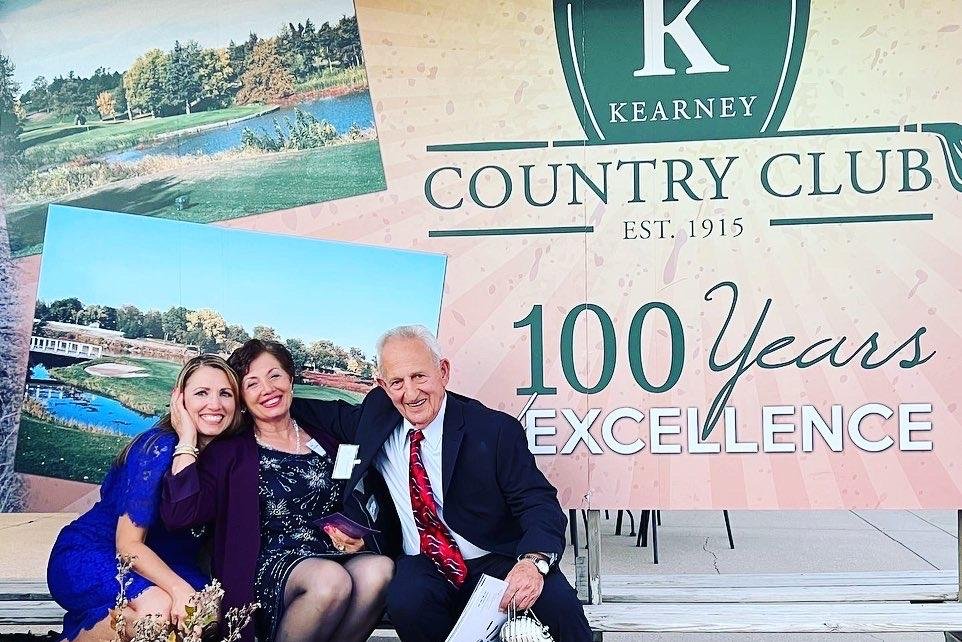
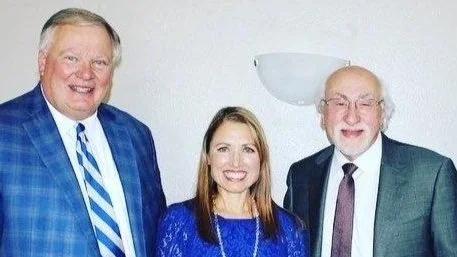
They learned about the work we are doing in Nebraska and I’m forever grateful to my family for being with me in Kearney for this occasion when we celebrated my transition to serving as the Buffett Institute/UNK Community Chair. My sweet father bought a bespoke new suit and shoes to come to Kearney. He looked handsome and I am so proud of him! My Mom also brought her new clothes for Kearney, and they gifted me three new dresses to choose from for my big day when people came for the celebration from Nebraska and beyond. I tried on all three dresses and modeled them for her. My Mom told me to wear the blue dress. When Mama tells you to do something, you must do it (even when you’re in your 50s). 

Marisa Galliano Macy, Elisabetta “Tina” Vacca Galliano, and Ronald Galliano

My parents taught me to work hard for a goal. A hot meal in morning is awesome when you jump out of bed before school. When we were growing up, my brothers (Rico and Mario) and I smelled food, but some days the smell of perm solution wafted up the stairs to our bedrooms as she was already doing someone’s hair in the beauty shop in our home before we woke up. Working parents juggle and I love my parents for modeling a strong work ethic for me. Without my parents, husband, daughter, family and friends I wouldn’t be able to do what makes me sparkle.

When we sign off on the phone my parents always say, “Make it a good one.” And of course ti amo (I love you).

Wishing you a good one today and everyday so you can be your best self for your family, friends and neighbors near and far. Dandelion wishes came true for me in 2022. One of them was with the terrific teams at Buffett Early Childhood Institute and UNK. Can’t wait to see what 2023 brings! Let good things grow with interconnectivity.

My husband Robert, daughter Adriana, and me

Dr. Sam Meisels the founding Executive Director of the Buffett Early Childhood Institute. He started the Buffett Institute 10 years ago with a mission to make Nebraska the BEST place to be a baby.

Robert, me, Adriana, Mom, Dad, my brother Rico Galliano, and Molly Dore who came from Seattle to be with us. I have a magnificent family and am so grateful for them.

I’m pointing at the Buffett Institute banner which has beautiful picture of Lucy who is the granddaughter of Sam and Alice Meisels.

The sensational Dr. Kate Gallagher, from Buffett Early Childhood Institute, and I speaking at the Inclusion Institute at University of North Carolina Chapel Hill. Dr. Gallagher is the Director of Research and Evaluation at Buffett Institute. She had my job at UNK before me. I love her. She is one of my mentors and role models. If you haven’t seen it yet, check out her TEDTalk entitled, “The Healthy Child: Assembly Required.” It is required viewing in the preschool methods class that I teach at UNK.

UNK Chancellor Doug Kristensen, me, & Dr. Meisels retired from Buffett Institute at University of Nebraska (left to right)

Adriana meeting Dr. Meisels for the first time.

Buffett team with the Buffett Advisory Board siting in front row with Dr. Meisels

Buffett advisory board member, Dr. Sharon Lynn Kagan, and me on our second day of board meetings October 2022 in Omaha. Pinch me…I must be dreaming!

My former student, Dr. Bingbing Zhang, who traveled from California to come to the Buffett celebration in Kearney, NE.

Dr. Walter Gilliam and I at the UNK Plambeck Early Childhood Center when he visited as a keynote speaker for the Nebraska Young Childhood Institute in June 2022. He is our new (as of March 1, 2023) Executive Director of the Buffett Early Childhood Institute of the University of Nebraska. Thrilled to have the brilliant and kind Dr. Gilliam with us in Nebraska.


User Experience

“Make it a good one.” He always says this right before we hang up the phone. I talk to my Dad almost everyday. During the COVID-19 pandemic we logged many hours discussing everything under the sun. I told him that I was struggling with how to best shift from face-to-face teaching to a virtual format. My child development students were out in the field serving children and their families when the rug was pulled from under all of us around St. Patrick’s Day of 2020. For safety reasons during the global health crisis, people were quarantined and social isolation became the new norm.

Students and I learned together how to do fieldwork when being in person was no longer an option. Trying to finish up the semester with high quality learning experiences for my students was my first priority (as shared here in a blog I wrote April 2020 - click here if you want to read it). The pivot was something we did together. We were not alone. The most magnificent community partners, like cooperating professionals who were supervising our college students, partnered with us. So many new and different field activities were explored. One of them was creating digital content for children and families. That is how we started.

I learned what our early childhood programs were doing and I brought it back to my practicum students and encouraged them to consider creating digital content too, if it fit their practicum placement. My friends at the Seminole County Early Learning Coalition invited my students and me to create videos reading picture books that they could share with families.

The first video I made for them was me singing, The More We Get Together, and then reading a story about routines like brushing teeth. Not my best performance, but heck that’s how we learn from experience. Right?! Rita Mae Brown said, “Good judgment comes from experience, and experience comes from bad judgment.” My second video was using the same format, but this time instead of doing it indoors I took the show on the road and recorded the video in my backyard.

My reasoning for moving the location of the video outside was that I wanted to show children and their families that outdoor reading could be a fun activity. Bring your books outside! I cringe just a little when I watch that video and hear the garbage truck in my neighborhood.

The Early Learning Coalition invitation inspired me in other ways too. I had been creating audio podcasts for BUTTERCUP. I still was making the audio podcast, but during the pandemic I started to use video podcast format since I was getting more comfortable with making digital content. However, I had no idea how the consumer was experiencing these videos that I was making. It is sort of a similar experience when I write and have no idea what the reader is taking away from the words I write down. When I teach, I can see my students’ faces and read their body language as a way to monitor their reaction and pace course content. With digital content, we may not understand or know the user experience.

User Experience (UX) is an important consideration when designing an engaging environment. Especially in the case of virtual environments, consider UX. Thinking about what the consumer sees is the visual design aspects of development. In addition to creating a visually interesting aesthetic, we also need to focus on the information architecture and interactions of the UX.

The ups and downs of the pandemic helped me to learn new ways of doing things. I still use the video format for my podcast. I have been learning a lot about lighting, cameras, and sound. Even two years after using this new approach to the podcast, I still struggle and that’s okay. We learn by doing is what Dr. Emer Ring recently said on Episode 52 (click here) of the BUTTERCUP podcast.

During my interview with Dr. Ring, the unexpected happened and my power went out. While she was talking, I quickly used my smart phone and logged back into the video conference without lights and camera.

I decided to keep Dr. Ring’s episode of the podcast as-is and not edit out the messy parts. WHY? I’m trying to model for my college students that on the merry-go-round of life there will be things that don’t go perfectly. Let’s give ourselves some grace. Things do not have to be perfect to be good.

So in the words of my Dad, “Make it a good one, my friends.” And by the way… it does not have to be perfect to be good.

My Dad (Ronald Galliano) and me on the carousel ride at Disneyland in Anaheim, California.


How Many?

If you went to work today, thank an early childhood educator! I want to make this sentence into bumper stickers, billboards, commercials, tweets that go viral, songs, and more to get the word out about the importance of the early childhood workforce for our communities. Professionals who work with young children allow our communities to prosper because of the solutions and supports offered to working parents. As a working mother, I am grateful to professionals who have poured their love and expertise into serving my child and our family. Their work allows me to go to work. Our community depends on early childhood educators and professionals. The Early Childhood (EC) workforce is the foundation for a prosperous community.

Yet, at the moment, the EC workforce is struggling with many challenges (e.g., pay, respect, adequate healthcare, their own childcare needs, food insecurity, and many more). Who can help us solve the EC workforce challenges? Maybe students can. Yesterday my university held a competition for students to come up with innovative solutions to problems. We had 137 students participate in the event. It was so cool to observe students use their creativity to solve issues that we all face. It reminded me of a game I play with children called, “How Many?” Did you ever play the “How Many” game? The game goes like this by asking the question, “How many ways can you get to _____?”

We play this game with my little one and she loves using mental math to answer the question. Our little one likes to say, for example, how can you get to 10 and then answer her own question by saying 5 plus 5 is a way to get to 10. Then, 7 plus 3 is 10. And… 2 plus 8 is 10. And… 14 minus 4 is 10. And so on. There are many ways to get to ten!

Maybe we can have community-wide brainstorming sessions where we play a version of the “How Many” game. How many ways can we get to better pay for our EC workforce? How many ways can we get to better resources for our EC workforce? How many ways can we get to better ______ for our EC workforce? Our neighborhoods can determine solutions to problems unique to our community. We have a commitment to honor the people who serve children and families with better pay, conditions, and respect. Innovations and creativity in solving childcare and teacher shortages are encouraged at this time. Our communities must unite to generate and try solutions that can make our neighborhoods stronger for all of us. How many ways can we thank our EC workforce?

If you went to work today, THANK an early childhood educator!

Dandelion Wishes

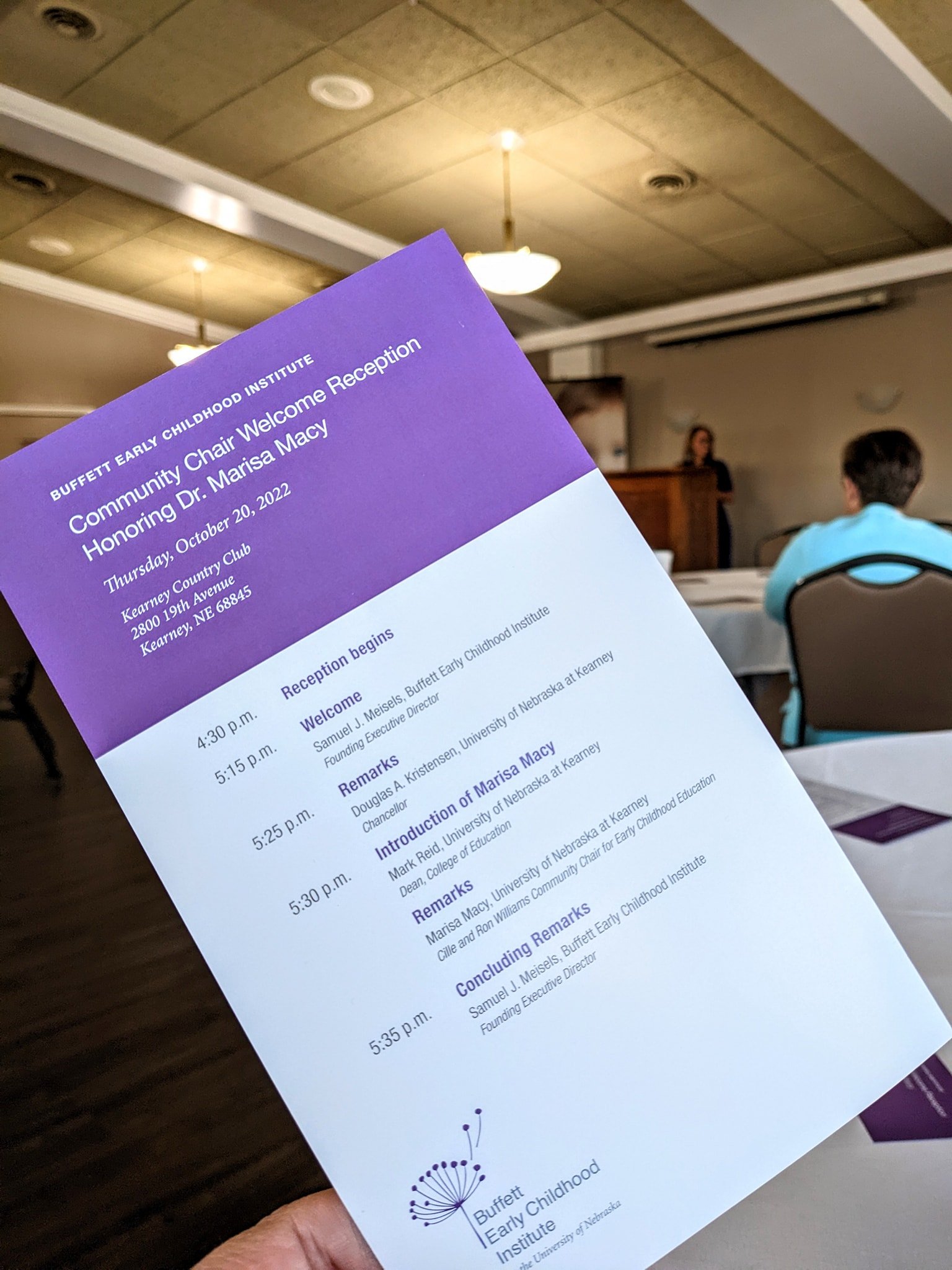
On July 1, 2022 I became the Community Chair of the Buffett Early Childhood Institute of the University of Nebraska. There are four possible Chairs that represent each campus in the University of Nebraska system for the Buffett Early Childhood Institute. Dr. Julia Torquati is the Buffett Early Childhood Institute Community Chair for University of Nebraska Lincoln. I am the Buffett Early Childhood Institute Community Chair for University of Nebraska Kearney. Both Buffett Early Childhood Institute Community Chairs for University of Nebraska Omaha and University of Nebraska Medical Center are currently vacant. Thursday evening, Buffett Early Childhood Institute threw me a party at the Kearney Country Club to celebrate our newly developed partnership. Below are my reflections on this occasion that I shared with everyone at the reception (and now with you).

Me at the College of Education at the University of Nebraska Kearney standing in front of the “Knowledge Tree” by artist Don Mitchell of Littleton, CO. The apple has 8 slices in it to represent educators who have made contributions: (1) Mary McLeod Bethune, (2) John Dewey, (3) Jaime Escalante, (4) Friedrich Froebel, (5) Thomas Jefferson, (6) Anne Sullivan Macy, (7) Helen Keller, and (8) Horace Mann. Photo by Erika Pritchard.

Being here today at the Kearney Country Club for a party thrown in my honor makes me feel so humbled to join the Buffett Early Childhood Institute’s team as the Community Chair representing the University of Nebraska Kearney (UNK) campus as part of our University of Nebraska (NU) system. I want to do two things: (1) express my gratitude, and (2) share what this opportunity as Buffett Early Childhood Institute Community Chair means to me.

Thank You

There are so many people to thank. First, thank you to Dr. Sam Meisels for inviting me to become the Buffett Early Childhood Institute Community Chair. His contributions to the early childhood field are remarkable, and I have immense respect for his pioneering work as the founding Executive Director of Buffett Early Childhood Institute. When I interviewed for my UNK job, I got to meet Dr. Meisels on Zoom and was star struck. I’d been a Meisels fangirl for many years, and used his works to inform my own in assessment, and measures he created called the Work Sampling System and Ounce. I am grateful to Dr. Meisels for his fabulous career and dedication to improving the lives of children and families, as well as for inviting me to be part of this prestigious team at the Buffett Early Childhood Institute. Thanks a million to the leadership team at Buffett Early Childhood Institute for welcoming me to be part of your family. I am thrilled for all the exciting ways we will collaborate to continue to make Nebraska the best place to be a baby.

I would like to thank my Dean, Dr. Mark Reid, from UNK College of Education for his leadership and all the ways he has inspired and supported me. One of my favorite quotes from Dean Reid is, “Professional and calm solves problems.” I’ve used this as a pep talk for myself. Many thanks to: NU President Ted Carter, NU Provost Jeffrey Gold, NU Vice Provost David Jackson, UNK Chancellor Doug Kristensen, UNK Vice Chancellor Kristen Majocha, UNK Graduate School Dean Mark Ellis, UNK CBT Dean Tim Jares, UNK Director of Research Sharon Obasi, UNK Office of Sponsored Research Travis Reynolds, Vice President of Alumni Relations & Development at the NU Foundation Lucas Dart, UNK COE Associate Dean Miechelle McKelvey & Assistant Dean Scott Unruh, Dept. Chairs Chandra Diaz and Kyle Luthans, and Assistant Teacher Education Chairs Dawn Mollenkopf and Rebecca Nelson. Getting to work alongside amazing people at UNK and NU who care deeply for our students and NU mission is such a joy. I can imagine it is hard work being an academic administrator and this All Star team make it look so easy.

My mentors have helped me navigate my professional life. Their mentoring has inspired me in so many ways to realize potential in myself and others. I am also grateful to my team in the Early Childhood Inclusive program, Dept. of Teacher Ed, COE, friends across UNK campus and UNK Plambeck Early Childhood Center, as well as friends in the NU system at our sister campuses that I’ve gotten a chance to work with since arriving in 2021. I am impressed everyday by the dedication you have to serving our students, contributing to research, and outreach. I am grateful for our Nebraska early childhood care and education workforce, children, and their families. My college students, past and present, are such a big part of my life and I am appreciative for all the ways college students teach me. Thank you: Mr. Ron Williams, Ms. Cille Williams, and the Williams family for creating the Ron and Cille Williams Endowed Chair in Early Childhood Education that has enabled me to focus on outreach as part of my job at UNK. With a smaller teaching load and resources, the Williams family endowment supports me as I strive to make lives better for children and families in Nebraska and beyond through high quality early childhood education.

It is with a thankful heart for my family that I get to do what makes me sparkle. I want to thank my wonderful husband, Robert Macy, who has encouraged me and supported me since I was a special education teacher, then when we were both graduate students at the University of Oregon, then as academics struggling to establish our careers, and co-parenting our smart, talented and kind-hearted daughter Adriana. Thank you precious Adriana Maria for making me a Mommy and the opportunity to watch you grow and develop into the supercalifragilisticexpialidocious person you are. When I told you both I wanted us to go to Nebraska, you sweetly jumped on board this grand adventure to the beautiful Heartland of America. I cannot thank you enough. I love you both so much! xo

Willa Cather wrote in her novel My Ántonia, “Ain't it wonderful, Jim, how much people can mean to each other?” Ron and Tina Galliano, my parents who traveled from Seattle to be here with us today, mean the world to me. They modeled for my two brothers and I how to respect and care for others whether it was serving people in their Italian restaurant or beauty shop. My Dad built a hair salon in our home and Mom served our community by doing hair for women in my hometown. Tuesday through Saturday we had people come into our home. My parents treated people in our community as though they were family. If one of Mom’s ladies in the beauty shop was celebrating something special or had a bad day, Mom would go in the kitchen and get her a pizzelle and little shot of Amaretto. I learned from Mom & Dad’s model how important it is to create a connection for everyone to feel included. Lifting up and serving others is rewarding. My brother and his girlfriend are also here with us today from Seattle, as well as a former student of mine who traveled from Bay Area to celebrate this special honor from Buffett Early Childhood Institute. Thank you for your gigantic hearts and being here today, Mom, Dad, Rico Galliano, Molly Dore, and Bingbing Zhang. Ti voglio molto bene.

What the Buffett Early Childhood Institute Chair Means to Me

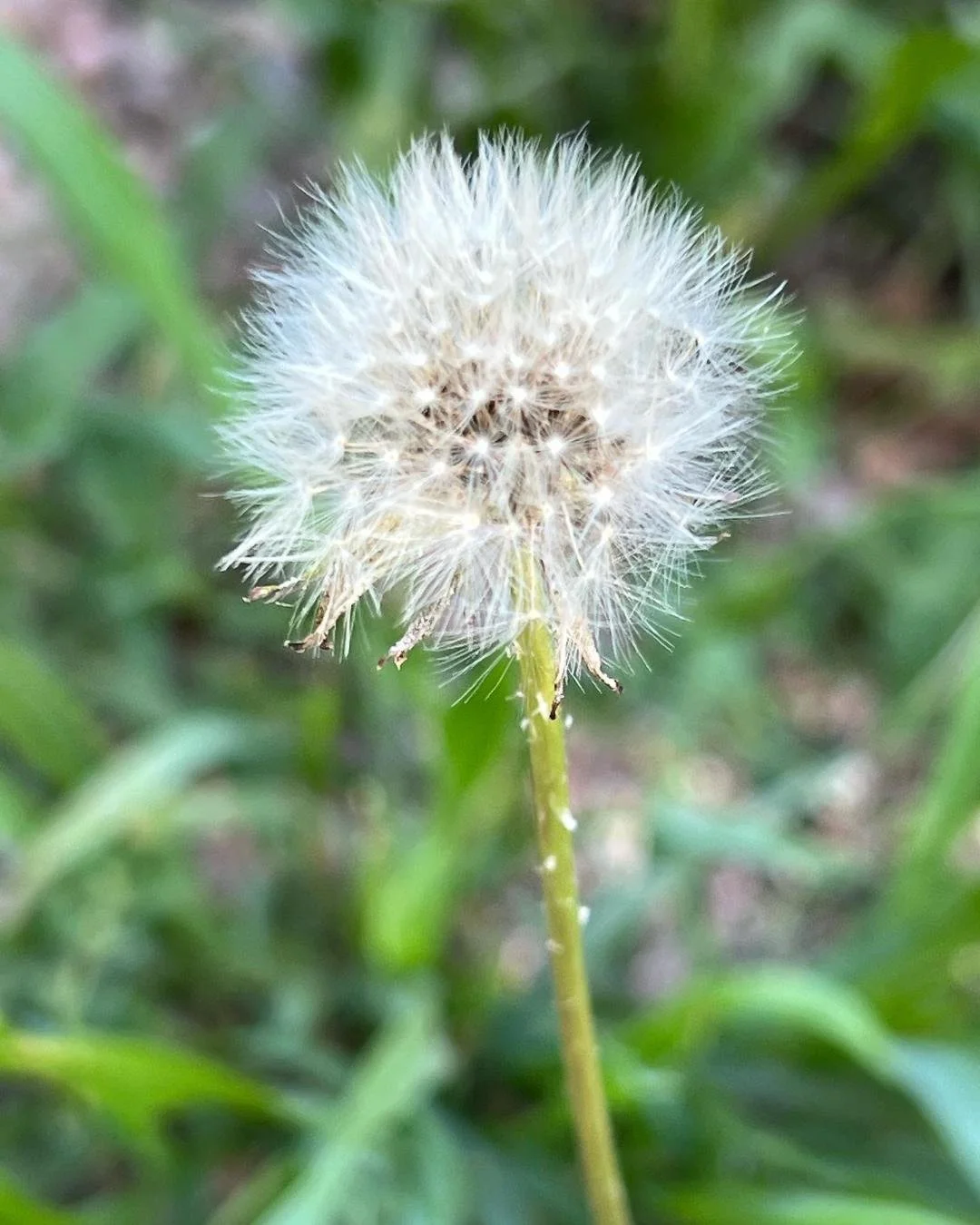
I love to find dandelions that have turned into magic puffballs. When I was a little girl growing up in Seattle, it was a magical time to find dry dandelions. It was only a matter of time until dandelions became damp and soggy from the Puget Sound mist. So, you had to time it just right. Pick fuzzy dandelions, make a wish, and then blow hard into the fluff and watch the seeds float into the air. Did you ever do that?

The seeds spread all over the place. I remember a recurring wish I would make back then. I was wishing I could grow up and become a teacher. For as long as I can remember I’ve had admiration for the teaching profession that started first by watching Mister Rogers’ Neighborhood on television. Teachers were, and are, like rock stars to me. My parents have a picture of me around age 3 where I have all my dolls assembled into a class and me teaching. Educators have always been elevated in my mind as a profession I aspire to become, respect, admire, and love with all my heart. What a beautiful logo of the dandelion for the Buffett Early Childhood Institute. On a spring trip to a conference, Dr. Kate Gallagher from the Buffett Early Childhood Institute, shared the story of the logo with me. The image is a symbol for transformation. From a tiny seed great ideas can be propagated into something grand. Buffett Early Childhood Institute represents for me how innovations and ideas can be spread to elevate the early childhood profession, as well as community outreach and research to benefit children and families.
My first class.

It is every child’s right to have access to high quality education and care in the early years. Yet, right now, many children and their families are missing out on a chance for early childhood education and care. This Chair allows me the privilege and opportunity to join the Buffett team in service to children, families, and our workforce. Welcoming collaboration!!! Open invitation to anyone hearing or reading this message. The Buffett Early Childhood Institute motto is, “Start early, start well.” Dandelion wishes could be planted and grown when we all come together.

This Chair means that I have resources to plant, nurture, and help grow good things for children with my Buffett Early Childhood Institute family. Pathways for community engagement is what this opportunity means to me. Together we partner with others to serve our communities through translational research, practice, policy, and outreach. The Institute’s mission is, “to transform the lives of young children by improving their learning and development.” We can realize this mission with the rapprochement of partnerships within our community to include education, health, legislative, government, non-profit, business, and social sectors to implement research-based early childhood services for children.  

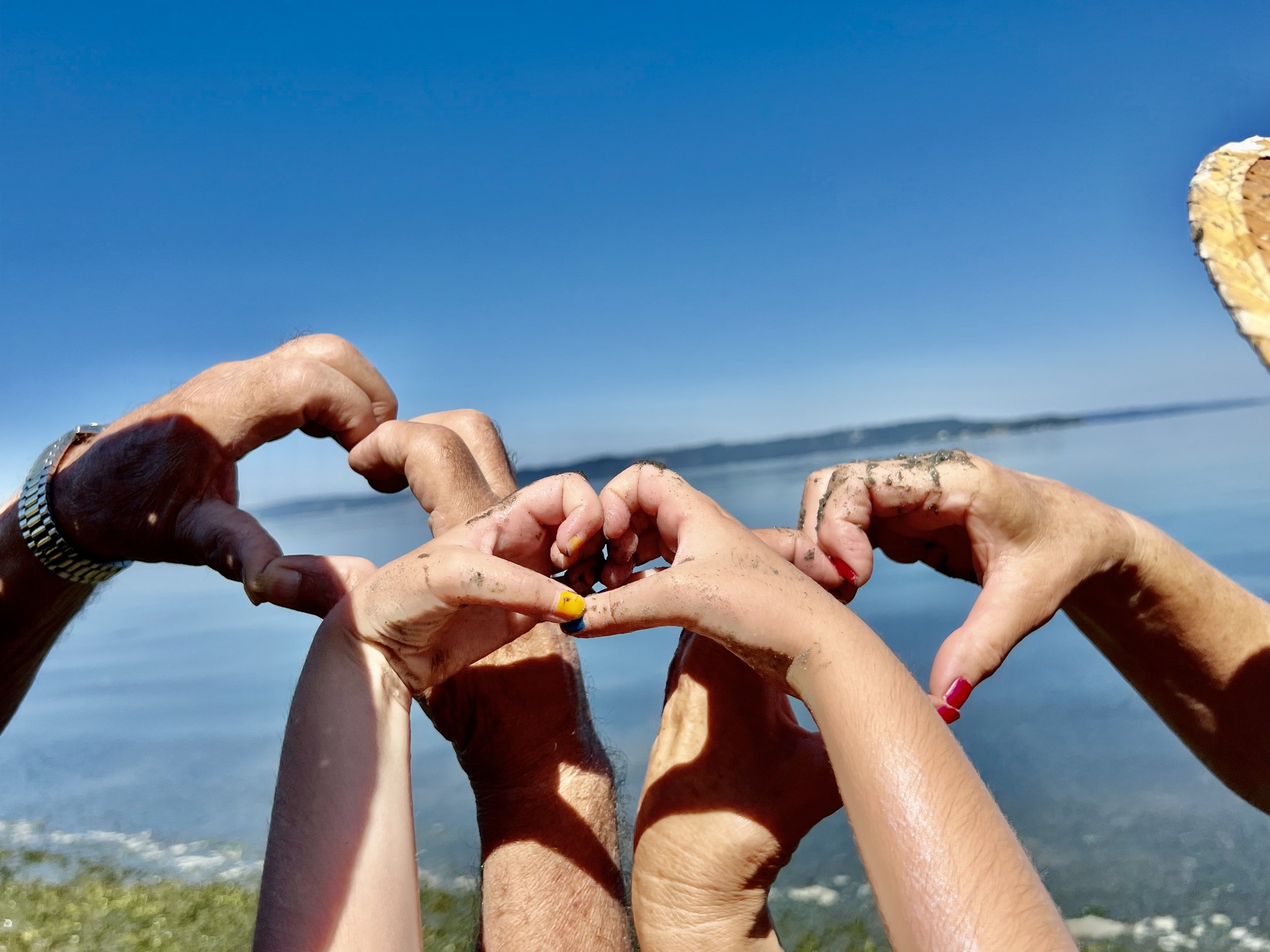
Hand in hand/mano a mano, we come together to make the world a better place with our energy and love for our children, families, neighborhoods, community, and each other. We do this by rolling up our sleeves and putting our hands to work to create something that is perennial. At UNK we can use our hand, or mano, to throw lopes by taking our thumb to the middle and ring fingers and leave the index and pinky fingers to dance in the air. It looks like an antelope’s horns. Lopers throw lopes to show our care for one another in our community. If you take that same position and just move the thumb out to the side (middle and ring fingers remain in palm of hand) you will be able to say, “I love you” in American Sign Language. I love YOU for all you do for our community and the children, their families, and our early childhood workforce. Willa Cather said, “Where there is great love, there are always wishes.” My dandelion wish for me and you is that we go together with all our hearts to make the world a better place for children everywhere.

I would like to leave you with some words by Fred Rogers. “In all that you do in all of your life, I wish you the strength and grace to make choices which will allow you and your neighbor to become the best of whoever you are.” xo

Make a wish.

Premack Principle

Routines can become boring. You know you are an early childhood educator when your natural instinct is to sing during transitions. Recently I was giving directions and sang a tune while going through the steps. That is one way to make routines less boring for children. Another way to spice up daily routines for children is to embed natural reinforcers into the routines.

Doing the thing you need to do is followed by the thing you desire to do. That is a basic explanation of the Premack Principle. An example of Premack Principle is telling your child to do their homework first, and then they can join the neighborhood kids and jump on the trampoline in the backyard.

In his book “Atomic Habits,” James Clear talks about a coach he interviewed where he asked what sets really good athletes apart from others, and what do they do differently. The coach responded by saying that exceptional athletes are those that can overcome the boredom of training. Doing the same thing over and over while working toward something is often necessary to reach optimal performance and goals without the loss of motivation along the way. Motivating factors could be explored. Can we use this concept of Premack to prime the environment for routines?

I use the Premack Principle at home and work. We have a busy week in my household. When we move through Monday to Friday and do what we need to do, we get to do something fun at the end of our week. Friday afternoons I pick my daughter up from school and we meet up with friends at a coffee shop and knit. At work, I condition my writing practice with reinforcement. Once I complete a writing project, I buy myself a present. The Premack Principle is doing the thing I need to do, followed by the thing I really want. Sometimes the thing I need to do is already motivating and may not need a reinforcer, but other times natural or external reinforcement helps to stay motivated.

How can we leverage routine activities to promote child development and learning? We can support positive behaviors by understanding what motivates each child. Make routines more attractive by helping the child get what they want. Learn what the child desires and then create time in the schedule to make it happen once the child does what they need to do. Make the routine(s) fun for the child. Provide timely feedback integrated into the routine. We can support children’s behaviors by paying attention to routines.

Clear, J. (2018). Atomic habits. An easy and proven way to build good habits and break bad ones. New York: Penguin Random House.

Kindness

“When we feel love and kindness towards others, it not only makes others feel loved and cared for, but it also helps us to develop inner happiness and peace,” ~Dalai Lama.

The Dalai Lama talks about how being kind can lead to our own peace and happiness. Kindness matters and our local businesses and non-profits were on board too with their own campaigns to spread the word. This move to the Heartland has been such a wonderful experience for me and my entire family. Grateful for my personal and professional rewards as I reflect on my moving anniversary. Not just in the Heartland but everywhere kindness is all around us. Maybe just being ready to look for it wherever we are is the key? Look for the kindness heartbeat where you are. What do you notice? How does it make you feel? How can we promote acts of kindness?

Poet, Mary Oliver, posed a question, “Tell me, what is it you plan to do with your one wild and precious life?" Let’s plan to cultivate kindness every day and everywhere. If you happen to see me driving by, wave! Please just assume that I’m driving slow (not to irritate you) because I’m checking on my animals or the corn. I’ll wave back thrilled to see you while enjoying this amazing ride. #makekindnessloud

Routines

Routines are an important part of our daily lives. As early childhood educators we might focus on children’s routines and schedule, but what about our own? Building a schedule of daily routines with clear expectations may help us reach daily goals. Start by looking at the day and what needs to get accomplished. Build in time for breaks and meals. Planning can ensure that we address our needs and priorities. Effective routines can help us feel safe and may lead to increased productivity. And another thing…don’t forget to play!

Reflections as an Intentional Practice

Have you ever wondered: “what do I do with the negative thoughts I feel?”

Mr. Fred Rogers asked children a similar question about what children can do with the mad they feel. It is a good question to ask when we are emotionally tasked with a challenging situation. For effective emotion regulation, adults can address negative thoughts and perceptions. Identifying negative thoughts starts with awareness. We can reflect on our negative thoughts to determine how they make us feel (Hole & McEntee, 1999). Stop and take a deep breath (Kamenetz, 2016). Inhale and exhale. Once calm, ponder how the thought makes you feel. What do you have to support or show that the negative thought is valid? Invalid? What could be a more accurate or different way to think about the negative thought? Sometimes we need to change the channel on thoughts like we do with the radio or television.

Compassion fatigue is real and can be a barrier to creating connections. We can address compassion fatigue by starting with ourselves to take time for self-care (Parlakian, Kinsner, & Gehl, 2018). Using praise and positive language is beneficial for children, as well as each other when we collaborate on teams. We can continue to strengthen the ways we build one another up by working on it everyday through communication and positive interactions (Goodwin, 2015; Jennings et al., 2017; Patti et al., 2018). Productive and positive conversations can be a foundation for trusting relationships.

If we create opportunities to practice, reflect, and monitor progress we can continue to get better. High-quality talk is something we can exercise like a muscle. What we practice all the time can become part of a more lasting or permanent repertoire. Practice does NOT make perfect. Instead practice makes permanent. What we practice again and again can stick. Reflect on feelings. Through reflections we can take time to ponder, wonder, and see the world and try to make sense of our feelings.

IMG_4402.JPG

References

Goodwin, B. (2015). Getting unstuck. Educational Leadership, 72. Retrieved from www.ascd.org/publications/educational-leadership/jun15/vol72/num09/Getting-Unstuck.aspx

Hole, S. & McEntee, G. H. (1999). Reflection is at the heart of practice. Educational Leadership, 56(8). Retrieved from http://www.ascd.org/publications/educational-leadership/may99/vol56/num08/Reflection-Is-at-the-Heart-of-Practice.aspx

Jennings, P.A., Frank, J.L., Doyle, S., Oh, Y., Rasheed, D., DeWeese, A., Cham, H., Brown, J.L., Davis, R., DeMauro, A.A., & Greenberg, M.T. (2017). Impact of the CARE for teachers program on teachers’ social and emotional competence and classroom interactions. Journal of Educational Psychology, 109(7), 1010-28.

Kamenetz, A. (2016). When teachers take a breath, students can bloom. National Public Radio. Retrieved from https://www.npr.org/sections/ed/2016/08/19/488866975/when-teachers-take-a-breath-students-can-bloom

Parlakian, R., Kinsner, K., & Gehl, M. (2018). Mindfulness for early childhood professionals. Zero to Three. Retrieved from https://www.zerotothree.org/resources/2269-mindfulness-for-early-childhood-professionals

Patti, J., Holzer, A., Stern, R., Floman, J., & Brackett, M. (2018). Leading with emotional intelligence. Educational leadership, 75. Retrieved from http://www.ascd.org/publications/educational-leadership/summer18/vol75/num09/Leading-With-Emotional-Intelligence.aspx

Establishing a Consistent Daily Schedule and Routines

It can be a challenge to create a consistent daily schedule and routines. Hough (2019) describes the importance of recognizing the struggle. Children, like us, need predictable routines and a daily schedule of events and activities that remain consistent. This alleviates stress. To implement predictable routines, analyze the daily schedule. Note what happens throughout the daily schedule. Determine where there are problem areas and times that seem to go smoothly, as well as times of the day that are challenging. Implement a plan to address the problem areas. Observe what happens when the plan is implemented by collecting informal and/or formal data. Avoid roadblocks by responding to data. Make data-driven decisions. Make changes when needed to modify schedule and/or routines. Routines can promote an environment that feels safe, secure, and welcoming (CESEFEL, 2007; Perry, 2000).


Sources: Center on the Social and Emotional Foundations for Early Learning. (2007). Helping Children Understand Routines and Classroom Schedules. Retrieved from http://csefel.vanderbilt.edu/kits/wwbtk3.pdf 

Hough, L. (2019) 5 Easy Steps to Helping Early Childhood Educators De Stress. Harvard Ed. Magazine. Retrieved from: https://www.gse.harvard.edu/news/ed/19/01/5-easy-steps-helping-early-childhood-educators-de-stress

 Perry, B. (2000). Creating an emotionally safe classroom. Scholastic. Retrieved from https://www.scholastic.com/teachers/articles/teaching-content/creating-emotionally-safe-classroom/

Motivation

Is there a sense of community and commitment to accomplish goal(s) for the organization? Workplace engagement is worthy of examination. Knowing ourselves is a building block for guiding and supporting organizational purpose.  In the movie “Stand and Deliver,” real life educator Mr. Jaime Escalante tells his students that in order to succeed we all need GANAS.

What is “ganas?” Motivation. Ganas is translated from Spanish to mean a desire to succeed. We need to stay motivated and be intentional in our commitment and purpose.

Questions we can ask ourselves are: do I know my organization’s purpose as well as my own, do I believe the work I do makes a difference, and can I grow and continue to learn new things (Jenkins & Quinn). When we know ourselves we can better connect with our purpose.

Reference:  Jenkins, J., & Quinn, T. (n.d.). Connecting people + purpose. Steelcase. Retrieved from https://www.steelcase.com/research/articles/topics/brand-culture/connecting-people-purpose/

Cruise, WA, etc. 010.jpg